Maggie Sensei

  • About Us
  • Fun Videos!
  • Maggie’s Room (~ 2019 Dec.31st)
  • Main Lessons Index
  • Mini Lesson Index
  • New Maggie’s Room (From Jan.1st. 2020 ~)
  • Please support us♥
Menu

Grammar, JLPT N3

The difference between さ & み ( sa & mi) suffixes to make a noun

April 17, 2017 37 Comments

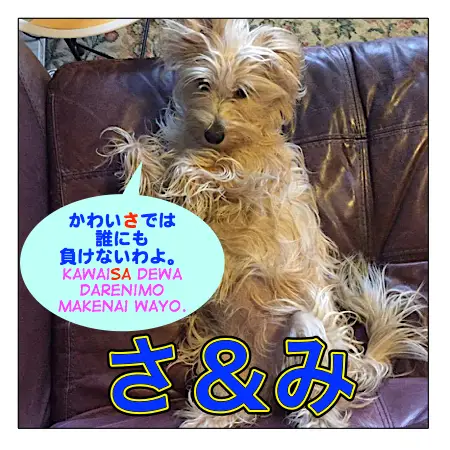
「かわいさでは誰にも負けないわよ。」

= Kawaisa dewa darenimo makenai wayo.

= Nobody can beat my “cuteness”

 

 「このドラマ面白みに欠けるよね。」

= Kono dorama omoshiromi ni kakeru yone.

= This drama lacks of interesting factor.

= This drama is kind of dull. 

 

Continue Reading
Become a Patron!


Click here to learn Japanese with JapanesePod101.com

Categories

  • Beginners
  • Business related
  • Colloquial
  • conversation
  • Daily Life
  • Emergency
  • Expressions
  • Female speech
  • Formal Japanese
  • French
  • German
  • Grammar
  • greetings
  • Hiragana
  • Japanese culture
  • Japanese customs
  • Japanese manners
  • Japanese song
  • Japanese tense
  • JLPT N1
  • JLPT N2
  • JLPT N3
  • JLPT N4
  • JLPT N5
  • Kanji
  • Katakana
  • male speech
  • Message from Maggie
  • Mini Lesson from No.124
  • particle
  • Polish
  • Practical
  • Proverbs
  • Sentence pattern
  • Slang
  • Spanish
  • Super Basic Words
  • transitive verb & intransitive verb
  • Travel Japanese
  • TV commercial
  • Uncategorized
  • useful phrases
  • Video follow up
  • Vocabulary
  • Volitional Form

Recent Comments

  • maggie on 敬語 ( = Keigo) Honorific Expressions Introduction
  • maggie on How to use 一緒= いっしょ= issho
  • Jen on 敬語 ( = Keigo) Honorific Expressions Introduction
  • Kaeith on How to use 一緒= いっしょ= issho
  • Kaeith on How to use 一緒= いっしょ= issho
  • About Us
  • Fun Videos!
  • Maggie’s Room (~ 2019 Dec.31st)
  • Main Lessons Index
  • Mini Lesson Index
  • New Maggie’s Room (From Jan.1st. 2020 ~)
  • Please support us♥

Maggie Sensei

Olsen WordPress Theme by CSSIgniter